
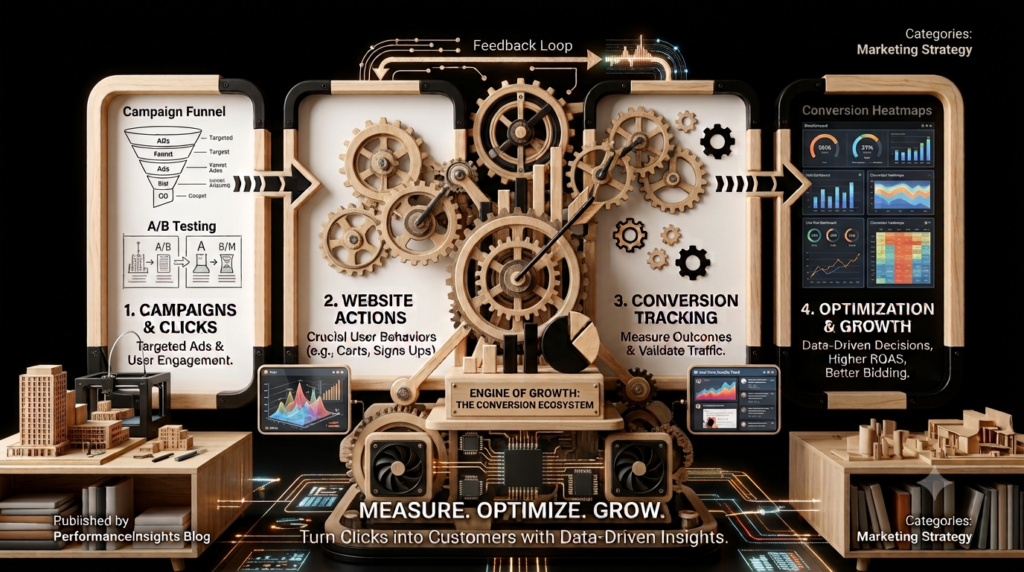
Performance marketing is all about achieving measurable results. Unlike traditional marketing, where businesses may focus mainly on visibility and brand awareness, performance marketing focuses on actions such as website purchases, form submissions, phone calls, app downloads, registrations, and leads. But how can a business know whether its advertising campaigns are actually producing results? This is where conversion tracking becomes essential.
Conversion tracking allows marketers to understand what happens after someone interacts with an advertisement. It helps businesses identify which campaigns, advertisements, keywords, platforms, and audiences are generating valuable actions. By using accurate conversion data, marketers can make better decisions, optimize advertising budgets, and improve overall campaign performance.
What Is Conversion Tracking?
Conversion tracking is the process of measuring specific actions that users complete after interacting with a marketing campaign. These actions are called conversions.
For example, an online store may consider a completed purchase a conversion, while a service-based business may consider a contact form submission or phone call a conversion. Other examples include newsletter sign-ups, product enquiries, account registrations, app installations, and bookings.
Tools such as Google Ads, Meta Ads Manager, Google Analytics, and Google Tag Manager can help marketers monitor these actions. By connecting advertising platforms with website or analytics data, businesses can determine which marketing activities are contributing to their goals.
Why Conversion Tracking Matters in Performance Marketing
- Measures Real Marketing Results
One of the biggest advantages of conversion tracking is that it measures actual results instead of relying only on impressions, likes, clicks, or reach.
A campaign may receive thousands of impressions and hundreds of clicks, but these numbers do not necessarily mean that the campaign is generating business. Conversion tracking shows whether those visitors actually completed the desired action.
This gives marketers a clearer understanding of campaign effectiveness and helps them focus on meaningful business outcomes.
- Helps Measure Return on Investment
Businesses invest money in digital advertising, so understanding the return on that investment is extremely important.
Conversion tracking helps marketers compare advertising costs with the revenue or value generated from conversions. For example, if a campaign spends ₹10,000 and generates ₹40,000 in sales, marketers can evaluate whether the campaign is delivering a profitable return.
This information makes it easier to determine which campaigns deserve more investment and which ones need improvement.
- Improves Advertising Budget Allocation
Without conversion data, marketers may distribute their advertising budget based on assumptions. With the help of conversion tracking, decisions will be made using facts.
Suppose one campaign generates 50 qualified leads while another generates only five leads with a similar budget. The marketer can identify the stronger campaign and allocate more budget toward it.
This helps reduce wasted advertising spend and allows businesses to invest more heavily in campaigns that produce valuable results.
- Identifies High-Performing Audiences
Different audiences can respond differently to the same advertisement. Conversion tracking helps marketers discover which audience segments are most likely to take action.
For example, marketers can compare conversions based on age groups, locations, devices, interests, customer types, or other available targeting factors.
These insights can be used to refine audience targeting and create more relevant advertising campaigns.
- Supports Campaign Optimization
Performance marketing requires continuous optimization. Marketers need to test advertisements, landing pages, audiences, keywords, and offers to discover what works best.
Conversion tracking will give you all the information that is required for optimization.
If an advertisement receives many clicks but produces very few conversions, the problem may be the landing page, offer, targeting, or messaging.
By identifying these performance gaps, marketers can make changes and measure the results.
Conversion Tracking and Customer Journey
Conversion tracking also helps marketers understand the customer journey. A user may first discover a brand through social media, later search for the business on Google, visit the website, and eventually make a purchase.
Tracking important actions across the customer journey provides valuable information about how users interact with different marketing channels.
This can help businesses understand which channels contribute to awareness, consideration, leads, and final conversions rather than judging every channel only by its last interaction.
Common Conversion Tracking Metrics
Several metrics can be monitored through conversion tracking, including:
- Conversion Rate: The percentage of users who complete a desired action.
- Cost Per Conversion: The average advertising cost required to generate one conversion.
- Cost Per Lead: The average amount spent to acquire a lead.
- Return on Ad Spend (ROAS):Revenue generated compared with advertising expenditure.
- Total Conversions: The total number of desirable actions completed.
- Conversions Value: The monetary value associated with conversions.
Monitoring these metrics helps marketers understand whether campaigns are meeting their objectives.
Best Practices for Effective Conversion Tracking
Businesses should first clearly define what counts as a conversion. Tracking too many unnecessary actions can make reports confusing.
Tracking should also be implemented correctly across websites and advertising platforms. Marketers should regularly test conversion events to ensure that data is being recorded accurately.
It is important to know the difference between primary and secondary conversions. For example, a completed purchase may be a primary conversion, while viewing a product page may be a secondary engagement action.
Finally, conversion data should be reviewed regularly rather than only at the end of a campaign. Continuous analysis allows marketers to identify opportunities and problems earlier.
Conclusion
Conversion tracking is one of the most important components of successful performance marketing. It transforms advertising data into actionable insights by showing marketers which campaigns, audiences, advertisements, and channels are generating meaningful business results.
By accurately tracking conversions, businesses can measure ROI, reduce wasted spending, improve targeting, optimize campaigns, and make data-driven decisions. In a competitive digital environment, simply generating clicks and impressions is not enough. Businesses need to understand what those interactions are producing.
Ultimately, “conversion tracking helps performance marketing become more measurable, accountable, and results-driven”, allowing businesses to spend their marketing budget more intelligently and build campaigns that deliver stronger long-term growth.